


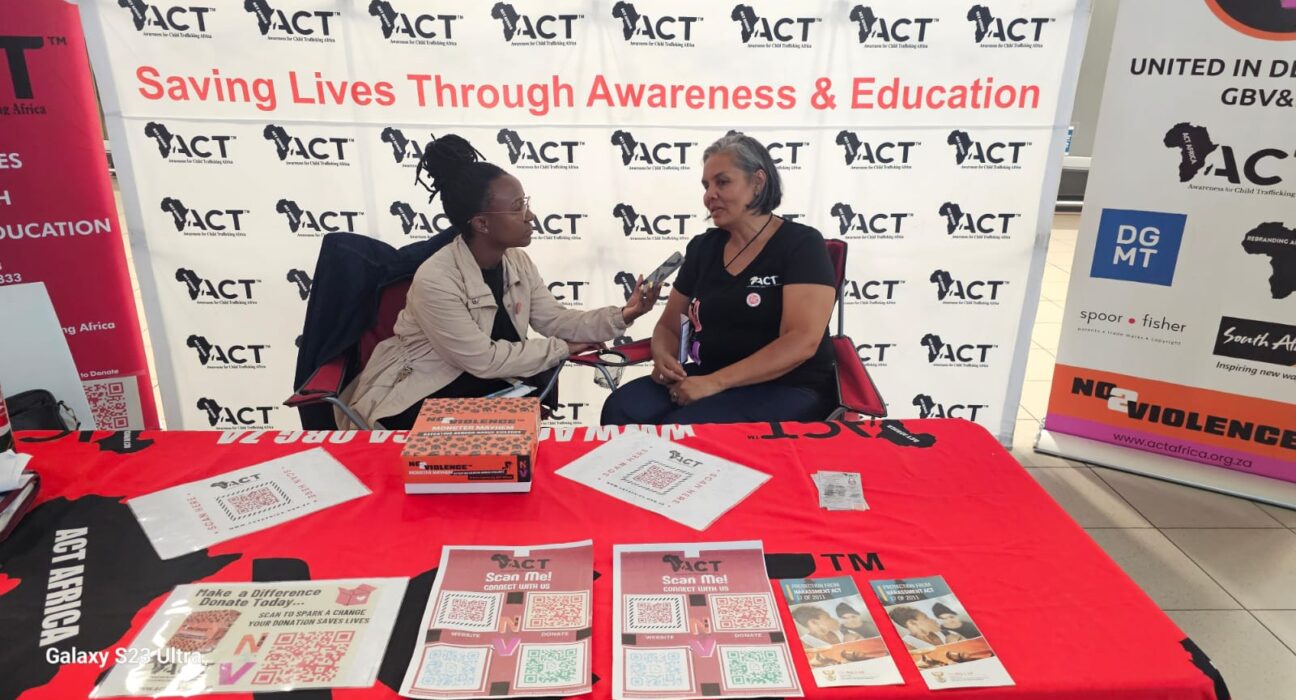
Some people arrive in advocacy through policy, profession, or public pressure. For Hillary Leong, the path began much earlier through survival, outside institutions, formal campaigns, or public recognition.
At thirteen, she survived an abduction. Decades later, she still describes that experience not simply as a traumatic memory, but as the point from which an unrelenting question took hold and never fully left her: What happens to those who never get away?
“That thought never left me,” she says. “I was blessed to get away, but what about those who never got away?”
That question would eventually shape the moral centre of her life’s work, long before the formal establishment of ACT Africa. What appears externally as a dramatic transition from wealth management and finance into anti-trafficking advocacy was, in her telling, less a sudden change than the visible emergence of something that had always existed beneath the surface.
“To start, this is a calling from God,” she says. “I have been involved in humanitarian work since my teens.”
Even while building a corporate career in finance, including work in wealth management and benefits administration, humanitarian service remained a parallel commitment. She moved between boardrooms and vulnerable communities, volunteering in orphanages, supporting women recovering from substance dependency, and gradually encountering the layered realities that often sit beneath what institutions classify too narrowly.
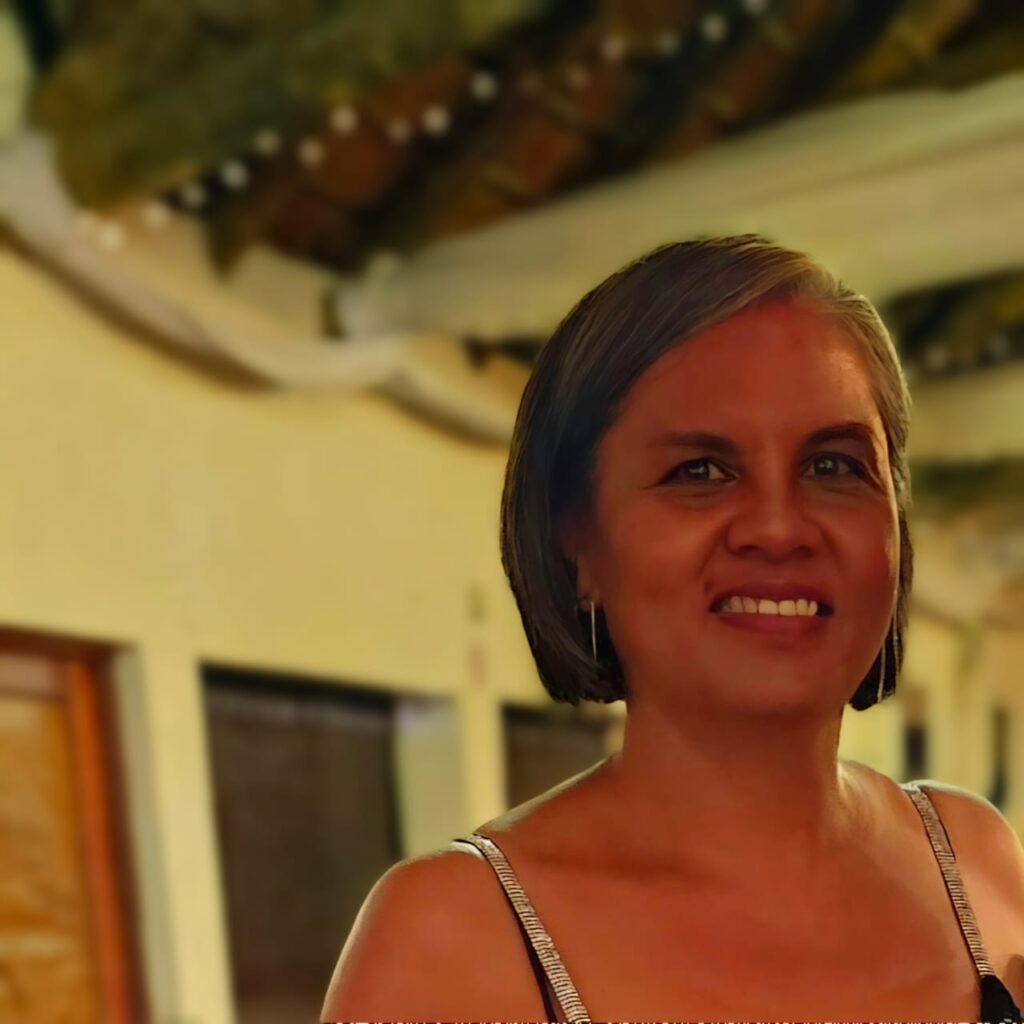
In many of those encounters, she noticed a pattern: women identified primarily as addiction cases were frequently carrying histories of coercion, exploitation, or violence that had never been properly named. Abuse, she learned early, rarely arrives with obvious labels. It often hides inside situations society has already decided it understands.
That recognition deepened over time, but another personal tragedy sharpened it into a more deliberate direction.
When her daughter’s close friend was murdered by her boyfriend, Leong and her family began a gender-based violence intervention in the young woman’s memory. What began as grief-driven action soon intersected with another growing area of concern: tracing missing persons, supporting rescue efforts for trafficked children, and understanding how often gender violence, disappearance, and trafficking overlap within the same fragile social systems.
What followed was not immediate institutional formation, but years of work carried informally case by case, relationship by relationship, often outside formal structures.
The official registration of ACT Africa came during one of the most uncertain periods of her own life.
In 2019, she became seriously ill while still in the corporate sector. Shortly after, she lost her job after refusing to participate in practices she describes as ethically unacceptable. What could have marked professional collapse instead became an unexpected opening.
“It was a blessing in disguise,” she says. “It gave me the time to officially register ACT Africa.”
That phrase “blessing in disguise” carries unusual weight when set against the circumstances she describes: illness, income disruption, and institutional separation. But for Leong, it was precisely the interruption of corporate life that created space for the work she had already been building informally to take formal shape.
What emerged was not simply a non-profit organisation, but a continental intervention model built around prevention, awareness, rescue support, survivor-centered advocacy, and institutional training.
Today, ACT Africa works across anti-trafficking advocacy, gender-based violence prevention, school education, law enforcement engagement, and community mobilisation, with operational roots in South Africa and growing networks across multiple African countries.
Yet the public face of advocacy, she insists, often obscures the private emotional cost required to sustain it.
“The emotional demand?” she repeats when asked. “A lot. I cry a lot, especially at two in the morning.”
There is no performative distance in the way she says it. Her answer is immediate, direct, and notably unpolished perhaps because no polished language adequately captures what it means to work daily with stories of disappearance, assault, exploitation, and preventable harm.
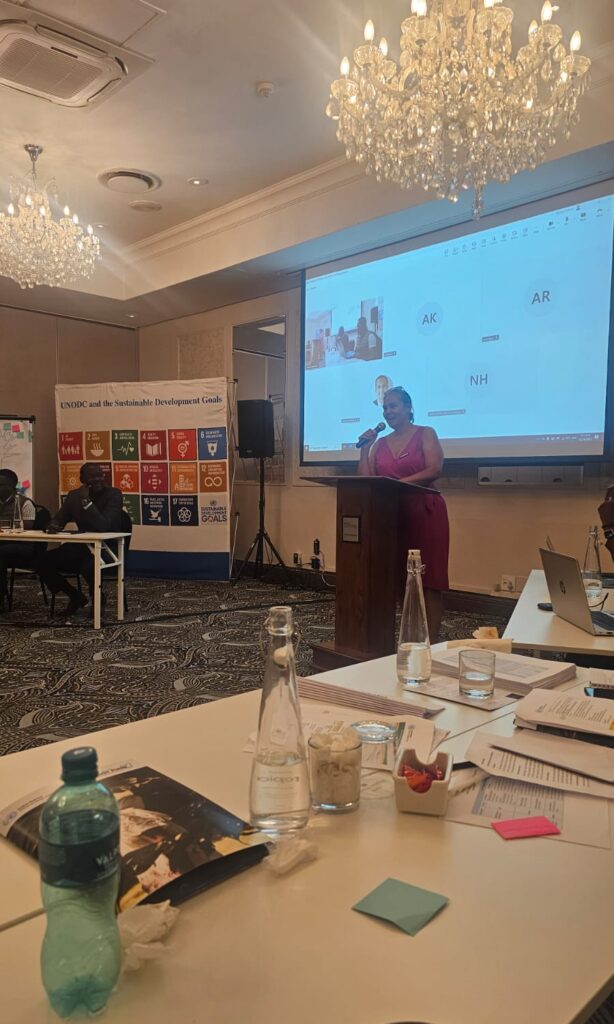
For leaders in humanitarian spaces, public recognition often arrives attached to campaigns, conferences, and visible interventions. What remains less visible is the cumulative psychological burden of repeatedly entering human pain while still carrying institutional responsibility.
For Leong, those burdens coexist daily.
There is the trauma brought by survivors and families. Then there is the administrative fragility familiar to many grassroots organisations: urgent needs paired with unstable resources.
“You look at an empty bank account,” she says, “and just have to look up and say, ‘God, it is in your hands.’”
That statement reveals a structural reality often absent from public conversations about advocacy in Africa: many organisations confronting some of the continent’s most urgent social harms operate under constant financial uncertainty, often led by individuals carrying both strategic and emotional labour simultaneously.
What keeps her focused is the conviction that trafficking remains dangerously misunderstood and that misunderstanding continues to protect traffickers more than victims.
“It is a very complex crime,” she explains. “Trafficking can be happening right in front of you, and you won’t realize it if you are not knowledgeable.”
Her argument challenges one of the most persistent misconceptions surrounding trafficking: that it is always dramatic, always visible, always linked to border crossings or organised criminal spectacle.
In reality, she says, trafficking frequently begins through trust.
A family member. A neighbour. A romantic partner. A community intermediary. Someone already known.
“People are trafficked by family or community members,” she says. “Desperation also creates vulnerabilities that traffickers exploit.”
That point is central to ACT Africa’s prevention philosophy. Poverty matters, but poverty alone does not explain trafficking. What matters equally are systems where desperation meets silence, weak protection structures, and communities that do not recognise warning signs early enough.
This is why education sits at the centre of the organisation’s intervention model.
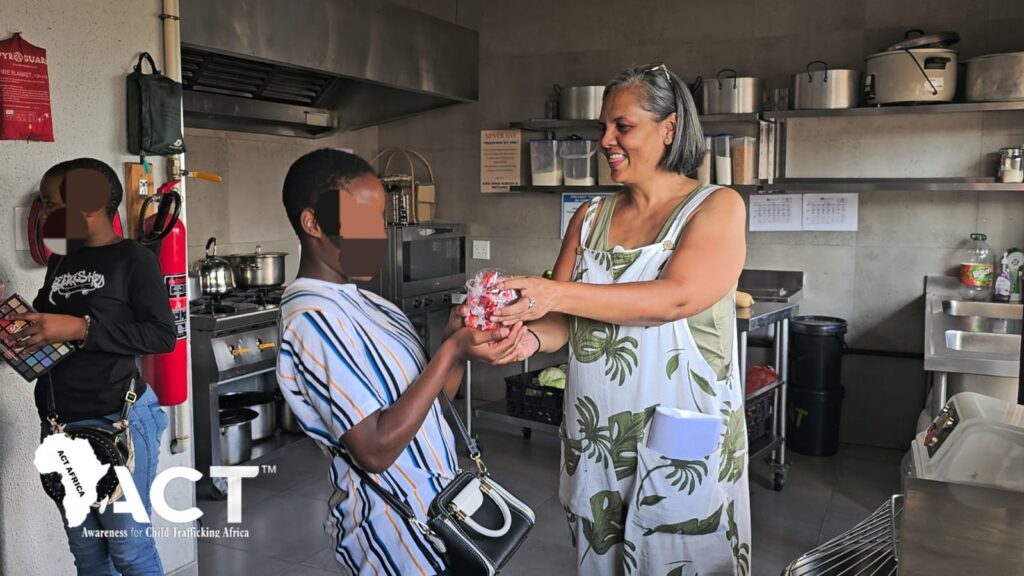
ACT Africa trains teachers, parents, corporate professionals, community leaders, and law enforcement personnel to identify indicators that often appear ordinary at first contact.
According to Leong, even police stations frequently receive cases initially classified under narrower categories rape, domestic violence, abduction without recognising trafficking indicators embedded within them.
“Even at the police station, they do not always recognise it at the onset,” she says. “We urge them to look deeper.”
That insistence on early recognition led the organisation toward one of its most distinctive prevention tools: child-focused educational design.
Rather than relying solely on lectures or awareness campaigns, ACT Africa developed prevention materials specifically designed around how children process risk.
For children aged ten and above, the organisation created a board game called No2violence (N2V). For younger children between five and ten, it designed a puzzle called Yes2Kindness(Y2V).
These are not classroom novelties. They are structured behavioural learning tools designed to help children identify unsafe conduct, understand bodily boundaries, recognise manipulation, and develop language around discomfort before abuse escalates.
“The board game has been endorsed by national and provincial departments in South Africa,” Leong explains.
Nearly 23,000 children currently have access to the material, a number that reflects meaningful reach, but still far below what she considers necessary.
The challenge, as with most preventive education work, is scale.
Funding determines how far prevention travels.
And for Leong, prevention must travel far beyond South Africa.
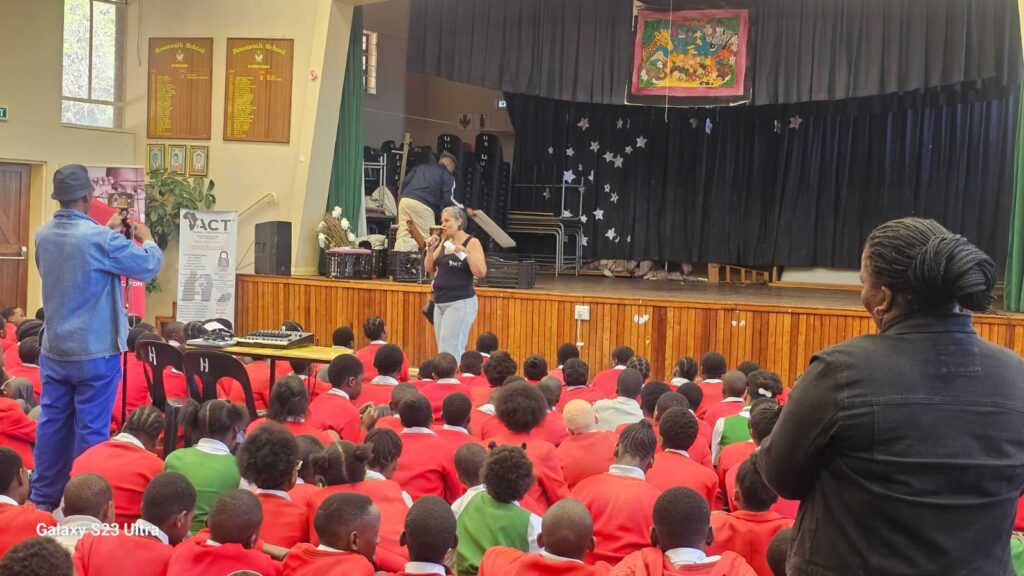
Though ACT Africa remains headquartered in South Africa, its volunteer and partnership network now extends into Nigeria, Ghana, Liberia, and Algeria.
At present, most formal coordination still routes through South Africa, but her long-term objective is the establishment of permanent bases in more African countries.
“We need to establish more bases across Africa to be more impactful.”
The rationale is practical rather than symbolic: trafficking patterns are intensely local. Prevention works best where communities can respond without waiting for cross-border coordination.
But building continentally also means confronting a harder institutional conversation one she raises without hesitation.
“The one thing prevailing throughout Africa is the issue of corruption.”
For Leong, trafficking cannot be discussed honestly without acknowledging how corruption weakens intervention at every level.
Her concern is not simply legislative absence. In many cases, she says, legal frameworks already exist.
The deeper problem is implementation.
“South Africa has excellent laws… but the implementation is the problem.”
That frustration comes from repeated encounters where systems designed to protect instead delay, deflect, or fail. Investigations stall. Cases weaken. Accountability dissolves.
Where institutions hesitate, traffickers benefit.
She also identifies another barrier less frequently discussed: institutional fear.
“When companies hear the word trafficking, they sometimes become scared.”
The fear, she says, often reflects concern about association as though anti-trafficking work belongs to dangerous territory rather than shared social responsibility.
Yet for Leong, distance is precisely what allows trafficking to remain socially invisible.
This is why she speaks about support not as charity, but as partnership.
“We encourage people not just to make a one-off donation but to partner with us to make a difference together.”
Support, in her framework, extends beyond financial giving.
It includes volunteer engagement, school-based awareness, workplace education, faith-community conversations, institutional collaboration, and public willingness to discuss exploitation where people still prefer silence.
Those who want to engage can contact ACT Africa through info@actafrica.org.za
for partnerships, volunteer pathways, funding support, and advocacy collaboration.
For Leong, however, the most important contribution remains cultural vigilance: more informed communities, more adults who notice early warning signs, more institutions willing to act before violence deepens.
Her long-term goal is measurable: fewer trafficking cases, lower gender-based violence rates, stronger prevention systems across African communities.
But she is equally clear that systems alone will not achieve that outcome.
“You can’t just wait for the government,” she says. “It starts with an individual saying, ‘It stops with me.’”
That sentence captures the underlying architecture of her work.
It is not built only around policy language or institutional advocacy, though both matter. It is built around moral participation , the idea that prevention begins when ordinary people stop assuming responsibility belongs elsewhere.
“No matter how poor you are, there is no excuse to abuse someone,” she says. “You always have a choice between right and wrong.”
That conviction may explain why her work resonates beyond formal advocacy circles. It speaks not only to state failure, but to everyday ethical responsibility.
And perhaps that is what makes Hillary Leong’s leadership particularly compelling: it is not driven by abstraction, but by memory, by a personal history she never converted into private silence, and by a continuing refusal to forget those whose escape never came.